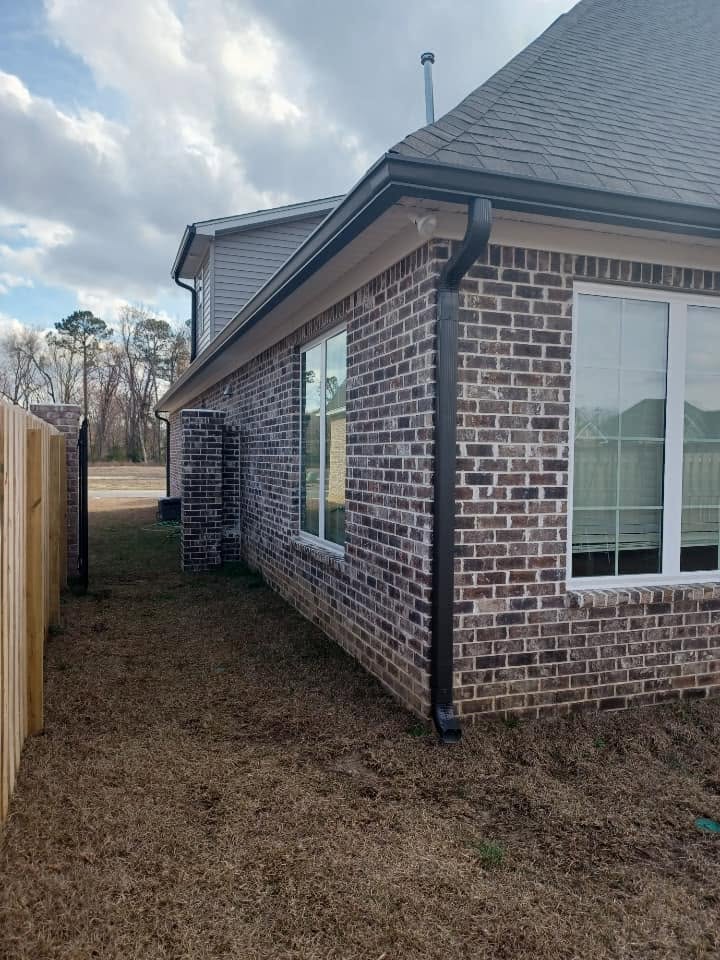
Gutters get all the attention. The downspouts are what actually move the water, and they are the part of a quote most people never think to question.
They are also the easiest place for a price to be quietly shaved. Leave two off a job and the quote drops, the gutter still looks right from the road, and nobody finds out until the first proper summer storm.
The short answer, and why it is not the whole answer
The rule of thumb we work to is an outlet every thirty to forty feet of run. On a straightforward single-storey home that usually lands somewhere around four to six downspouts in total.
Treat that as a starting point rather than an answer. It is a reasonable guess before anybody has looked at your roof, and on plenty of houses it turns out to be wrong in one direction or the other. What follows is what shifts it.
What actually sets the number
How much roof drains into each run
This is the one that matters most, and it is not the same as the length of the gutter. A short section of gutter catching the runoff from a large expanse of roof is doing far more work than a long section under a narrow slope.
When we measure, we are looking at the roof above each run and working out how much water is going to arrive there, then placing outlets so no single one is asked to swallow more than it can.
How far the water has to travel
A gutter is pitched to move water along it, but only gently — too much slope and it looks wrong against the fascia. On a long run with a single outlet at one end, water arriving at the far corner has a long way to go before it can leave.
In steady rain that is fine. In a downpour, the far end fills faster than the trough can carry it and spills over the front edge. Splitting a long run so it drains to outlets at both ends solves that without touching anything else.
Valleys
Where two roof planes meet, everything landing on both of them is funnelled into one narrow channel and delivered to a single point on the gutter below. The volume arriving there is out of all proportion to the length of gutter receiving it.
Any valley discharging into a short section needs an outlet close by. If you have a spot that overflows every single time it rains hard while the rest of the house is fine, walk out and look up. There is usually a valley directly above it.
The pitch of the roof
A steep roof does not collect more rain than a shallow one, but it delivers what it collects a great deal faster. The gutter sees a sharper peak rather than a steady flow, and peaks are what cause overflow. Steeper roofs generally want their outlets closer together.
The way it rains here
This is worth saying plainly, because it is where advice written for somewhere else falls down. Our rain does not arrive politely. A Pee Dee summer storm can drop more in twenty minutes than some parts of the country see in a week, and a system sized for gentle, sustained rainfall will be overwhelmed by it.
We size for the storm, not the drizzle. That is the whole reason our downspout counts sometimes come in above a cheaper quote.
Signs you do not have enough
You do not need to count anything to work this out. The house will tell you.
- It only overflows in heavy rain. Light rain is fine, hard rain sheets over the front. A clogged gutter overflows in both. This pattern points at capacity instead.
- The same spot every time. One corner or one stretch that always goes, while the rest of the house copes.
- Erosion or a trench below one point. A channel worn into a bed, or a bare patch in the grass, marks where water has been coming over repeatedly.
- Splashback up the siding. Dirt or staining low on the wall under a particular section.
- A sag in the middle of a long run. Standing water is heavy. A run that holds it for too long will eventually pull on its hangers.
Any of those is worth a look. Several together and the system is undersized rather than simply blocked.
Where the water goes once it is down
Getting water off the roof is half the job. Getting it away from the house is the other half, and a downspout in the wrong place can do more harm than no downspout at all.
Emptying against a foundation is the one to avoid — it puts a concentrated volume of water exactly where you least want it, over and over. Dumping across a walkway or a drive is a nuisance in summer and genuinely dangerous on a cold morning. Discharging onto a neighbour’s side of a boundary causes the kind of problem that is much easier to design out than to resolve afterwards.
Splash blocks, extensions and underground runs to daylight all solve this. Which one suits depends on your ground and your landscaping, and it is part of what we work out on site rather than something to decide from a photograph.
Can you add them to gutters you already have?
Usually, yes, and it is one of the most cost-effective repairs we do. If the existing run is sound and hung properly, cutting in an extra outlet and dropping a new downspout is a small job that often fixes an overflow somebody has been living with for years.
It is also the first thing to try before anybody talks you into replacing a whole system. If the gutter itself is fine and the problem is capacity, replacing it changes nothing — you would just have a newer gutter overflowing in the same place.
Why this is the line cheap quotes cut
Downspouts are priced separately from the gutter run, which makes them the easiest thing to trim without the total looking obviously light. Two fewer outlets is a meaningful saving on paper and invisible on a finished job until the weather tests it.
So when you are comparing quotes, compare the downspout counts as carefully as the price. If one is noticeably cheaper, check the number of outlets and where they are going before assuming you have found a bargain. It is the same point we make about what actually drives the cost of a gutter job.
Have somebody look at it
If your gutters overflow in a storm, we will come out and tell you whether it is a blockage, a pitch problem or simply not enough outlets — and which of those is worth spending money on. Estimates are free across Florence, Darlington and Hartsville, with no obligation.
Call 843-992-7619 between 8am and 7pm, Monday through Saturday, or send us the details and we will arrange a time.